
Couples Counseling to Strengthening Relationships and Effective Communication.
Relationships thrive on connection, trust, and mutual understanding, with communication serving as the foundation for these elements. When partners struggle to express their needs, resolve conflicts, or truly hear one another, misunderstandings can erode intimacy and create distance.
Couples counseling offers a structured, supportive environment to address these challenges, helping partners rebuild their connection through improved communication.
This process fosters emotional closeness, encourages vulnerability, and equips couples with tools to navigate both everyday interactions and complex disagreements.
Below, we explore how couples counseling enhances communication, promotes healthier dynamics, and supports lasting relationship growth.
The Role of Communication in Relationships
At its core, communication is the bridge that connects partners, allowing them to share thoughts, emotions, and expectations.
Effective communication goes beyond words—it includes tone, body language, and the ability to listen actively.
When communication falters, partners may feel misunderstood, ignored, or invalidated, leading to frustration or resentment. Common issues include frequent arguments, avoidance of difficult topics, or a lack of emotional openness.
Couples counseling addresses these patterns by helping partners identify their communication styles and understand how these styles impact their relationship.
Counseling provides a safe space to practice new ways of interacting. For instance, one partner may tend to dominate conversations, while the other withdraws.
A counselor can guide the couple toward balanced dialogue, ensuring both voices are heard. By fostering empathy and mutual respect, counseling helps partners move from reactive or defensive exchanges to collaborative problem-solving. This shift not only resolves immediate conflicts but also builds a stronger foundation for future interactions.
Creating a Safe Space for Open Dialogue
One of the primary benefits of couples counseling is the creation of a neutral, non-judgmental environment. Partners often enter counseling with pent-up frustrations or unresolved issues, making it difficult to discuss sensitive topics without escalating into conflict.
A skilled counselor facilitates open dialogue by setting ground rules, such as avoiding blame and focusing on feelings rather than accusations. This structure encourages partners to express themselves honestly while feeling safe from criticism or retaliation.
In this setting, couples learn to articulate their needs and emotions more clearly. For example, instead of saying, “You never listen to me,” a partner might learn to express, “I feel unheard when we discuss important decisions.”
This subtle shift in language reduces defensiveness and invites understanding. Counselors also teach active listening techniques, such as paraphrasing what a partner has said to confirm understanding. These skills help partners feel valued and foster a deeper emotional connection.
Communication Barriers
Every relationship faces communication barriers, whether due to differing personalities, past experiences, or unmet expectations.
Couples counseling helps identify and dismantle these obstacles. For instance, some partners may struggle with vulnerability due to fear of rejection, while others may avoid conflict to maintain harmony.
A counselor can uncover these underlying dynamics and guide the couple toward healthier ways of engaging.
One common barrier is the tendency to assume a partner’s intentions or feelings without verifying them. This can lead to misinterpretations and unnecessary conflict.
In counseling, partners practice checking assumptions by asking open-ended questions, such as, “Can you help me understand what you’re feeling right now?”
This approach promotes clarity and reduces the likelihood of escalating tensions. Additionally, counselors may introduce exercises to improve non-verbal communication, such as maintaining eye contact or using affirming gestures, which can enhance emotional intimacy.
Developing Conflict Resolution Skills
Disagreements are inevitable in any relationship, but how couples handle conflict determines whether it strengthens or weakens their bond.
Couples counseling equips partners with practical tools to navigate disputes constructively. Rather than allowing arguments to spiral into blame or silence, partners learn to approach conflicts as opportunities for growth and understanding.
A key aspect of conflict resolution is learning to manage emotions during heated moments. Counselors often teach techniques like taking a brief pause to cool down before continuing a discussion.
This prevents impulsive reactions that can escalate tensions. Additionally, partners are encouraged to focus on the issue at hand rather than bringing up past grievances, which can derail productive conversations.
By practicing these skills, couples develop the ability to resolve disputes without damaging their emotional connection.
Another important tool is the use of “I” statements, which allow partners to express their perspectives without accusing or criticizing the other.
For example, saying, “I feel overwhelmed when we don’t plan our time together,” is more constructive than, “You always ignore our schedule.” This approach fosters collaboration and helps partners work together to find solutions that meet both of their needs.
Rebuilding Trust Through Communication
Trust is a cornerstone of any healthy relationship, but it can be eroded by poor communication, unmet expectations, or past hurts.
Couples counseling provides a pathway to rebuild trust by addressing the root causes of disconnection. Through guided conversations, partners can explore how their communication patterns have contributed to feelings of mistrust and work toward repairing these wounds.
For example, if one partner feels betrayed by a lack of transparency, counseling can help them express this pain while the other learns to respond with empathy rather than defensiveness.
Over time, consistent and honest communication fosters a sense of reliability and safety. Counselors may also introduce trust-building exercises, such as sharing small, positive appreciations daily, to reinforce emotional closeness. These practices help partners rediscover their connection and strengthen their commitment to one another.
Conclusion
Couples counseling offers a transformative opportunity to strengthen relationships by improving communication. Through a safe and structured process, partners learn to express their needs, resolve conflicts, and rebuild trust. The skills developed in counseling—such as active listening, emotional vulnerability, and collaborative problem-solving—create a foundation for lasting connection and growth.
While the journey requires effort and commitment, the rewards are profound: a relationship that is more resilient, intimate, and fulfilling. By embracing the tools and insights gained in counseling, couples can navigate life’s challenges together, building a partnership that thrives on mutual understanding and respect.
From Start to Finish: Therapy & Counseling in 3 Steps
1.
Book a free initial consultation to share your concerns and explore how therapy can support your mental health goals.
2.
After understanding your needs, your therapist will design a personalized therapy plan, incorporating approaches like CBT or mindfulness to address your unique challenges.
3.
Begin your therapy sessions—available in-person or online—with flexible scheduling options, and let your therapist guide you toward growth and emotional well-being.
Our Experience
Keyword Ideas (anxiety therapist near me, anxiety and OCD therapist, online anxiety therapy California, social anxiety California, relationship anxiety therapist)
Have Questions? We’ve Answers for You.
Find answers to your questions about therapy, Muna’s services and specialization, Insurance, or privacy here.
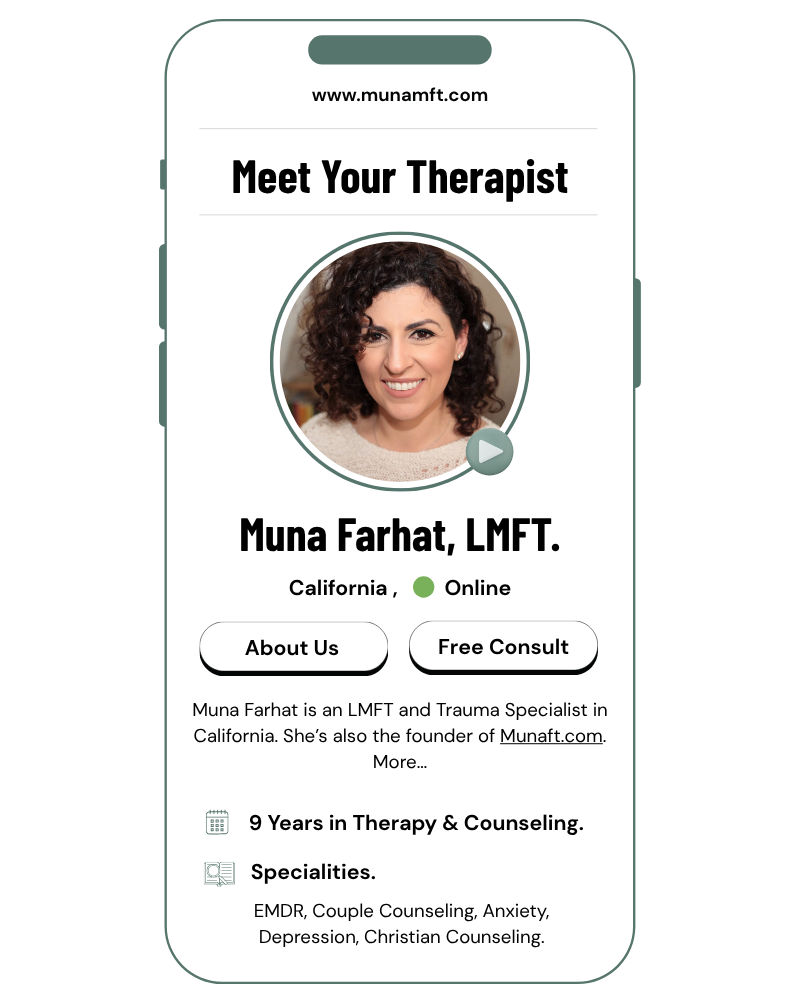
Muna Farhat, LMFT is a Licensed Marriage and Family Therapist based in San Jose, CA.
She holds the necessary credentials to practice therapy in California, with expertise in supporting individuals, couples, and families through various emotional and relational challenges.
As a Licensed Marriage and Family Therapist, Muna adheres to strict confidentiality standards outlined by California state law and the Health Insurance Portability and Accountability Act (HIPAA).
Your personal information is securely stored and only shared with your explicit consent, except in legally mandated situations.
Therapy is a collaborative process where you work with a trained professional, like Muna, to address emotional, mental, or relational challenges. It can help you gain insight, develop coping strategies, and achieve personal growth or resolution of specific issues.
Counseling and therapy are often used interchangeably, but counseling typically focuses on specific issues or short-term goals (e.g., coping with a life transition), while therapy may involve deeper exploration of long-standing patterns. Muna offers both, depending on your needs.